Embodied AI: A New Paradigm
Embodied AI refers to artificial intelligence systems that interact with and learn from their physical environments through a combination of sensors, motors, machine learning, and natural language processing. These systems enable applications like autonomous vehicles, humanoid robots, and warehouse automation to perceive, reason, and act in real-world settings.
We’re witnessing a significant shift in how AI systems work. Unlike traditional AI that operates in digital environments, embodied AI must navigate the complexities of the physical world. This creates new challenges and opportunities that are reshaping industries from logistics to healthcare.
Digital AI vs. Embodied AI
To see why embodied AI isn’t just an incremental upgrade, compare it side-by-side with traditional AI.
| Aspect | Digital-Only AI | Embodied AI |
|---|---|---|
| Environment | Virtual datasets, simulations | Real-world physics, humans, obstacles |
| Sensors | N/A | Vision, touch, audio, proprioception |
| Actions | Software outputs, recommendations | Physical movements, object manipulation |
| Challenges | Data bias, model overfit | Sensor noise, dynamics, safety |
This contrast highlights how physical interaction fundamentally changes design priorities - forcing us to solve for dynamics, safety, and real-world friction.
Multimodal Sensory Integration
Multimodal sensory integration is a cornerstone of embodied AI, enabling systems to process and synthesize information from multiple sensory channels simultaneously. These systems combine vision, touch, audio, and language to form comprehensive environmental understanding.
This integration allows embodied agents like robots to perceive their surroundings more holistically, similar to human cognition, leading to more natural and adaptive interactions. For example, a robot might combine visual data with tactile feedback to successfully grasp objects or integrate audio cues with visual information for improved navigation.
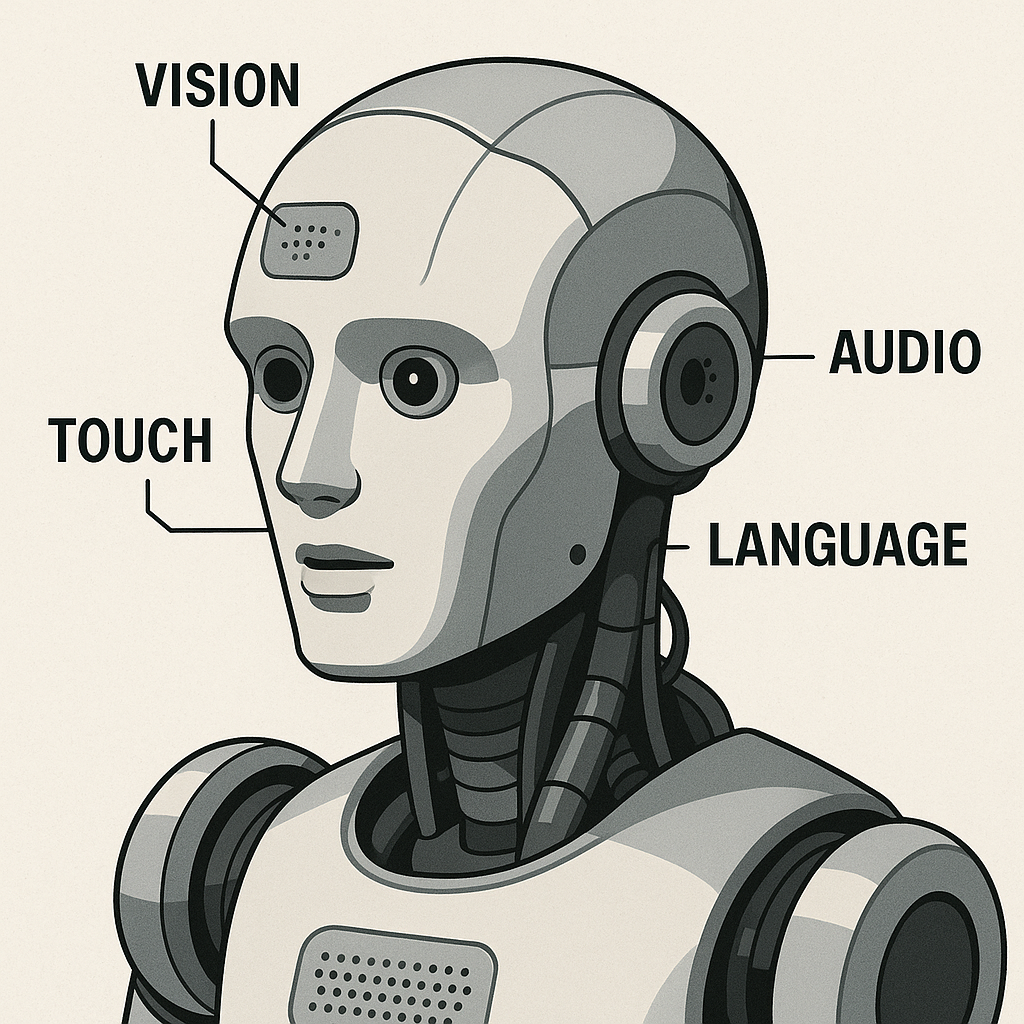
Key Aspects of Multimodal Integration
- Fusion of Diverse Sensory Inputs: Systems create unified representations by combining vision, touch, and sound data from their environment.
- Real-Time Processing: Multimodal data must be processed quickly to enable responsive decision-making in dynamic environments.
- Cross-Modal Learning: Information from one sensory channel can enhance understanding in another, creating more robust perception systems.
- Language Integration: Natural language processing combines with sensory data to enable human-robot communication and instruction.
- Specialized Neural Architectures: Advanced neural networks are designed specifically to process and align information across different sensory modalities.
Warehouse Robotics Applications
Faced with labor shortages and surging demand, warehouses have become crucibles for embodied AI - innovations that learn, adapt, and scale in real time.
Embodied AI has revolutionized warehouse operations through sophisticated robotic systems that combine physical capabilities with advanced intelligence. These systems address critical challenges in the logistics industry, including labor shortages, fluctuating demand, and the need for continuous operations.
Autonomous Mobile Robots
Warehouse robots powered by embodied AI navigate complex environments without predefined paths or extensive infrastructure modifications. Companies like Locus Robotics deploy autonomous mobile robots (AMRs) that work alongside human workers to optimize order fulfillment processes.
These robots use sensors, cameras, and AI algorithms to navigate dynamically around obstacles and people, adapt routes in real-time based on warehouse conditions, and learn optimal pathways through repeated interactions with the environment.
Pick-and-Place Automation
Imagine a robotic arm effortlessly picking a fragile glass ornament, sensing its weight and texture, then placing it safely without human aid - that’s the level of dexterity embodied AI delivers today.
Advanced robotic arms equipped with embodied AI can identify, grasp, and manipulate a wide variety of items. Covariant’s AI Robotics platform exemplifies this technology, using their “Covariant Brain” powered by RFM-1 (Robotics Foundation Model) and trained on extensive multimodal datasets from warehouses worldwide.
These systems can pick virtually any SKU or item without specific programming, handle products of different shapes, sizes, weights, and materials, and adapt to changing inventory without requiring reprogramming.
Productivity and Implementation Benefits
Embodied AI warehouse solutions offer significant operational advantages. Sereact’s implementation model demonstrates how these systems can be deployed rapidly, often within a single day, without requiring extensive training.
The benefits include cost savings of up to 77% compared to manual operations, 24/7 operation capability, seamless handling of peak demand periods, and increased throughput and accuracy in fulfillment processes.
Bipedal Robots for Complex Tasks
More advanced embodied AI applications include bipedal robots like Agility Robotics’ Digit, which can carry and place items in warehouses while making dynamic adjustments to maintain balance and navigate challenging environments.
These humanoid-like robots represent the next frontier in warehouse automation, capable of performing tasks previously limited to human workers, navigating stairs and uneven surfaces, and adapting to warehouse layouts designed for humans.
Telepresence and Disaster Response
NimbRo Avatar Systems
Robotic avatar systems represent a groundbreaking application of embodied AI. The NimbRo team from the University of Bonn achieved remarkable success in this field, winning the ANA Avatar XPRIZE competition in 2022 with a perfect score and securing the grand prize of $5 million.
Their system enables users to virtually transport themselves to remote locations through an operator station connected to an avatar robot via the internet, creating a seamless telepresence experience.
The NimbRo avatar system exemplifies advanced embodied AI principles through robust immersive telepresence that provides visual, auditory, and tactile feedback to operators, bimanual telemanipulation capabilities with force and haptic feedback, and real-time environmental sensing.
Disaster Response Technologies
In disaster zones where human entry is perilous, embodied AI steps in as first responder - scouting, mapping, and even delivering lifesaving aid.
Embodied AI in disaster response represents a significant advancement in emergency management, combining artificial intelligence with robotics to create systems that can navigate hazardous environments where human access is limited or dangerous.
These autonomous robots equipped with advanced sensors can swiftly assess affected areas, identify survivors, locate potential hazards, and provide real-time information to aid decision-making.
Here’s how these systems are deployed now:
- Search and Rescue Operations: Autonomous drones, ground robots, and snake-like robots navigate through debris and collapsed buildings using thermal imaging and ultrasonic sensors.
- Damage Assessment: Real-time visual and sensor data help emergency teams strategize response plans efficiently.
- Hazardous Material Handling: Specialized robotic systems minimize human exposure to dangerous substances.
- Medical Aid Delivery: Autonomous drones and robotic vehicles deliver supplies to areas with blocked or unsafe roads.
Autonomous Inventory Management Systems
Autonomous inventory management systems represent a significant advancement in warehouse automation, combining robotics, AI, and sensor technology to transform traditional inventory tracking processes.
Types of Autonomous Inventory Systems
Aerial Drone Solutions: Autonomous drones like those developed by Corvus Robotics navigate warehouse aisles using advanced computer vision and neural networks rather than GPS or infrastructure markers. These drones can scan barcodes and RFID tags on pallets stored at heights up to 14 meters.
Autonomous Mobile Robots: Ground-based robots equipped with extendable scanning towers can automatically extend to reach the tallest racks and use both LiDAR and cameras to simultaneously scan every pallet within a rack. Dexory’s systems can scan up to 12,000 pallets per hour with 99.9% accuracy.
Benefits and Impact
For warehouse staff, this means fewer hours perched on scissor lifts scanning barcodes - and more time analyzing flow, troubleshooting exceptions, and optimizing operations.
- Increased Scanning Frequency: Traditional inventory management typically involves manual counts performed once or twice yearly, whereas autonomous systems enable weekly or even daily inventory checks.
- Operational Efficiency: Autonomous inventory systems eliminate the need for manual scanning using forklifts or scissor lifts, which averages less than 100 pallets scanned per hour.
- Real-Time Data Integration: These systems integrate with warehouse management platforms to create digital twins of physical spaces, providing warehouse managers with real-time visibility of every location in their warehouse network.
Core Industry Components
Think of these modules as a robot’s nervous system: perception gathers stimuli, decision-making interprets them, action executes, and feedback refines the loop - forming a continuous cycle of embodied intelligence.
flowchart LR Perception --> Decision Decision --> Action Action --> Feedback Feedback --> DecisionEmbodied AI systems integrate four fundamental modules that work together to create intelligent machines capable of interacting with the physical world.
1. Perception Module
The perception module serves as the sensory system for embodied AI, collecting environmental data through various sensors including visual systems, tactile sensors, audio processing, and proprioception (internal position sensing).
These perception systems generate massive amounts of multimodal data that must be processed in real-time, driving demand for specialized AI chips and edge computing solutions.
2. Decision-Making Module
The decision-making module represents the “brain” of embodied AI systems, processing sensory data and determining appropriate actions through reasoning engines, planning systems, and knowledge bases.
This component has seen significant investment from companies developing specialized AI models for robotics applications, with firms like Covariant creating foundation models specifically designed for robotic manipulation tasks.
3. Action Module
The action module translates decisions into physical movements through mechanical systems including actuators, end effectors, and locomotion systems.
This sector includes specialized manufacturers of robotic components as well as integration companies that combine off-the-shelf parts into custom solutions.
4. Feedback Module
The feedback module monitors task execution and provides data for continuous improvement through performance monitoring, error detection, and learning mechanisms.
This component is critical for enabling robots to adapt to new situations and improve over time, representing a key differentiator between traditional automation and true embodied AI.
Industry Leaders and Innovators
Leading companies are pioneering embodied AI technologies across various industries, creating systems that integrate physical capabilities with advanced intelligence.
Figure AI is developing general-purpose humanoids designed to eventually enter homes and workplaces.
Agility Robotics offers Digit, a bipedal robot bringing flexible automation to manufacturing operations through mobile manipulation capabilities.
Covariant has established itself by delivering robotics foundation models that meet real-world reliability and flexibility requirements for industrial automation.
Several innovative startups are also making significant contributions:
- Mbodi AI provides a platform that seamlessly integrates generative AI into existing robotics stacks, enabling natural language teaching and real-time adaptation.
- Sanctuary AI creates systems that closely mimic human movement and cognitive processes, specializing in dexterity and tactile feedback for industrial tasks.
- Sereact offers pick-and-place automation solutions that can be deployed within a day without requiring specialized training.
AI Chips and Infrastructure
Behind every agile robot lies silicon engineered for parallel computation - chips that define how quickly a machine can perceive, plan, and react to the world around it.
NVIDIA’s Market Leadership
NVIDIA dominates the AI chip market with approximately 80% market share, particularly in graphics processing units (GPUs) that power AI applications. The company’s success stems from its early focus on GPUs for gaming that proved ideal for parallel computing tasks essential to AI.
- Desktop AI Solutions: DGX Spark is NVIDIA’s desktop AI supercomputer designed for AI engineers and data scientists. Priced around $3,000, it’s comparable in size to a Mac mini and powered by the NVIDIA GB10 Grace Blackwell Superchip.
- Datacenter Solutions: NVIDIA’s datacenter offerings include chips based on its Ampere, Hopper, and most recently, Blackwell architectures.
Major Competitors
- AMD (Advanced Micro Devices) has been NVIDIA’s main rival and continues to compete in the AI chip space, with plans to release its own server product by the end of 2025.
- Broadcom has emerged as a significant player in custom AI chips (ASICs), which are built for specific processes rather than general processing.
- ARM Holdings focuses on licensing processor designs to manufacturers, with low-power designs particularly well-suited for edge AI applications.
Cloud Service Providers
Major cloud service providers are increasingly developing their own AI chips, including Google’s TPU, AWS’s Trainium and Inferentia, and Microsoft’s Maia.
Critical Materials Supply Chain
Every embodied AI system - from warehouse robots to autonomous vehicles - depends on a complex web of critical materials that most people never think about. These materials don’t just power the computers; they enable the sensors, actuators, and specialized components that allow machines to perceive and interact with the physical world.
But here’s the challenge: many of these materials face significant supply chain vulnerabilities, environmental concerns, and geopolitical risks that could fundamentally constrain the growth of embodied AI systems. Understanding these dependencies is crucial for anyone building, investing in, or planning around these technologies.
The Hidden Material Dependencies
When you see a warehouse robot smoothly navigating between shelves or a humanoid robot manipulating delicate objects, you’re witnessing the culmination of an intricate material ecosystem. Each component - from the silicon chips processing visual data to the rare earth magnets powering precise motor control - represents a potential bottleneck in global supply chains.
The materials that enable embodied AI fall into several categories, each with distinct characteristics, supply risks, and strategic implications. Some are abundant but require specialized processing. Others are rare but essential for cutting-edge performance. All are interconnected through complex supply chains that span continents and cross geopolitical boundaries.
Foundation Materials: The Building Blocks
The most fundamental materials for embodied AI systems are the elements that form the backbone of all modern electronics and mechanical systems. These “foundation materials” appear in virtually every component of an embodied AI system, from the processors and memory chips to the structural frames and heat management systems.
Silicon (Si) serves as the substrate for virtually all AI processors and sensors, from 5 nm FinFET logic chips to edge-AI modules. High-purity silicon wafers require energy- and water-intensive refinement processes, making semiconductor fabs significant local water users. The precision required for AI chips means that any disruption to silicon supply chains can cascade through the entire embodied AI ecosystem. (pubs.usgs.gov)
Copper (Cu) is critical for power delivery, data interconnects, and thermal management in robotics and data centers. Modern embodied AI systems require substantial amounts of copper for everything from charging systems to the intricate wiring networks that connect sensors to processors. Climate-driven water stress in key copper-mining regions could disrupt 32% of chip production by 2035, quadrupling current risks and threatening semiconductor supply chains. (reuters.com)
Aluminum (Al) is widely used for structural frames, heat sinks, and chip packaging. Its lightweight properties make it especially valuable for mobile robots and drones, where every gram of weight affects performance and battery life. However, over 60% of global primary aluminum smelting now occurs in China, and Western smelters face closure pressures as Chinese processing costs undercut international competitors. (reuters.com)
Specialized Materials: The Performance Enablers
Beyond the foundation materials, embodied AI systems require specialized elements that enable advanced capabilities like high-frequency sensors, powerful actuators, and long-lasting energy storage. These materials often have limited global production and concentrated supply chains, making them particularly vulnerable to disruption.
Gallium (Ga) is key for GaN and GaAs power electronics, RF devices, and advanced sensors that enable robots to perceive their environment with precision. Global production (~450 t/yr) is predominantly a byproduct of Chinese zinc and bauxite refining, creating a significant supply bottleneck. Rio Tinto’s first primary-gallium extraction (with Indium Corp) marks a strategic step toward diversified supply, but production remains constrained. (reuters.com)
Rare Earth Elements (REEs) including neodymium, dysprosium, terbium, and samarium are essential for high-strength permanent magnets in servo motors and actuators. These materials enable the precise motor control that allows robots to manipulate objects with human-like dexterity. Although these 17 lanthanide elements are relatively abundant geologically, nearly 80% of heavy-REE processing remains in China - leaving global robotics magnet supply vulnerable to export curbs. (usgs.gov, reuters.com)
Battery Metals (Li, Co, Ni) power mobile robots, drones, and wearable exoskeletons. Lithium-ion chemistries provide the energy density needed for robots to operate untethered for extended periods. However, recycling rates lag behind demand, and new mining projects struggle with environmental permitting and community resistance, creating long-term supply constraints for autonomous systems.
Supply Chain Vulnerabilities and Strategic Responses
The material dependencies of embodied AI create several categories of risk that extend far beyond simple supply and demand. These vulnerabilities reflect broader geopolitical tensions, environmental challenges, and economic imbalances that could significantly impact the development and deployment of embodied AI systems.
| Risk Vector | Impact | Mitigation |
|---|---|---|
| Geographic Concentration | China dominates Al, REEs, Ga/GaAs refining | New midstream plants (e.g., Rio Tinto gallium pilot) |
| Climate-Driven Disruptions | Water stress threatens Si wafer fabs and Cu mines | Desalination, water-reuse projects in Chile/Peru |
| Economic Underinvestment | Western smelters uncompetitive vs. subsidized China | EU Critical Raw Materials Act; U.S. DOE funding for REEs |
| Recycling Shortfalls | Low Li-ion and magnet recycling rates | Circular-economy mandates; pilot chemical-recovery facilities |
The strategic responses to these vulnerabilities are already reshaping global supply chains. Governments are implementing critical materials policies, companies are diversifying their supply sources, and researchers are developing alternative materials and recycling technologies. However, the timeline for these solutions often extends beyond the rapid deployment schedules of embodied AI systems.
Key Takeaway: Embodied AI performance and scalability are inseparable from material availability, geopolitical dynamics, and environmental constraints. The companies and countries that secure resilient access to these critical materials will have decisive advantages in the embodied AI revolution. Understanding these dependencies isn’t just about supply chain management - it’s about understanding the fundamental constraints that will shape the future of physical AI systems.
Manufacturing Process Breakdown
Screw Manufacturing Example
The creation of a screw involves a sophisticated manufacturing process that transforms raw metal into precisely engineered fasteners. Most modern screws are manufactured through cold forming (also called cold heading), which shapes metal without heating it, enhancing strength through work hardening.
The process begins with selecting appropriate raw material, typically steel wire, which is cut into uniform slugs that serve as the starting point for the screw body.
Manufacturing Sequence:
- Heading: The metal slug undergoes multiple strikes in high-pressure machines to form the screw head
- Trimming: A trimming press shapes the head to exact specifications
- Pointing: The end opposite the head is angled to facilitate initial insertion
- Thread Rolling: Dies press into the screw blank to form threads
- Quality Assurance: Completed screws undergo dimensional inspection
- Finishing: Many screws receive protective coatings like zinc electroplating
Why focus on a screw? Because even the simplest fastener must meet exacting tolerances - one loose component can ground an entire fleet of robots, making hardware precision as vital as software intelligence.
You can imagine how humanoid robots and other innovations would impact the production of every kind of material. The projected impact of this technology cannot be overstated.
Supply Chain Roles
The production of a single screw involves numerous specialized roles across the supply chain. At the sourcing stage, Purchasing Agents procure materials and negotiate with suppliers, while Supplier Quality Engineers ensure incoming materials meet quality standards.
Manufacturing positions include Production Planners who develop schedules, Quality Control Inspectors who verify products meet specifications, and Production Technicians who monitor quality and productivity.
Production Costs
The cost of producing a single screw varies dramatically based on quality, application, and production volume. Standard hardware store screws cost mere cents to manufacture, while specialized industrial screws used in critical applications can cost $25 or more per unit.
This price disparity reflects not just material differences but also quality assurance processes, compliance with safety standards, and specialized manufacturing requirements.
Global Manufacturing Hubs
China’s Manufacturing Dominance
China has emerged as the dominant manufacturing hub for embodied AI systems, capturing approximately 70% of the global market share. This leadership position stems from the country’s well-established manufacturing ecosystem, advanced supply chain infrastructure, and strategic government investments.
In June 2025, Pacini Perception Technology opened the world’s largest embodied AI data facility in Tianjin Municipality, spanning 12,000 square meters and equipped with 150 data units developed in-house.
Manufacturing Advantages:
- Manufacturing Ecosystem: Shenzhen has approximately 210 companies specializing in embodied AI, with ready access to vital components
- Supply Chain Efficiency: Proximity to suppliers has dramatically shortened procurement timelines
- Government Support: The Chinese government has invested approximately $138 billion in robotics and AI development
- Data Collection Infrastructure: Comprehensive facilities for training embodied AI systems
Other Global Manufacturing Centers
- Japan: SoftBank Robotics Group leads with humanoid robots like Pepper and NAO, known for emotional AI and interactive learning capabilities.
- Switzerland: ABB is a global leader in robotics and automation, offering embodied AI robots for automotive, aerospace, construction, and healthcare sectors.
- Germany: KUKA AG specializes in intelligent cobots and robotic platforms for smart factories.
- United States: Boston Dynamics is recognized for agile robots like Atlas and Spot, used in logistics, defense, and construction.
As China, Japan, and the U.S. vie for manufacturing supremacy, control over these supply chains could be a decisive lever of geopolitical and commercial power in the age of embodied AI.
Market Size Projections
The embodied AI market is experiencing significant growth, with varying market valuations reported across research firms. In 2024, the global embodied AI market reached approximately USD 2.5 billion, driven by increasing demand for intelligent machines capable of perceiving, moving, and interacting with the physical world.
Growth Projections
- Market.us: The market is expected to grow at a CAGR of 15.7% from 2025 to 2034, reaching approximately USD 10.75 billion by 2034.
- TBRC Research: Projects a growth rate of 18.6%, with the market expanding from USD 2.73 billion in 2024 to USD 3.24 billion in 2025.
- MarketsandMarkets: Presents a more aggressive growth forecast, projecting the market to expand from USD 4.44 billion in 2025 to USD 23.06 billion by 2030, representing a CAGR of 39.0%.
Regional Distribution
North America currently dominates the global embodied AI market, accounting for over 41.3% of the market share in 2024, with a value of approximately USD 1.03 billion.
This leadership position is attributed to strong research and development activities, early adoption of embodied AI technologies, and the presence of major technology companies and research institutions.
Market Segmentation
By product category, robots dominate the embodied AI market, holding a 40.9% market share in 2024, driven by increasing deployment of humanoid robots, autonomous drones, and robotic assistants.
In terms of end-use industries, the automation and manufacturing sector led with a 27.1% market share in 2024, highlighting the strategic importance of embodied AI in enabling smart factories and driving Industry 4.0 adoption.
Everyday Impact Timeline
Embodied AI won’t land overnight. First it might slip into back-office workflows, then into our homes, until one morning you wake and find your coffee brewed by a roaming countertop bot.
Near-Term Impact (2025-2030)
By 2030, embodied AI might increasingly integrate into everyday life, transforming how people interact with technology and reshaping urban landscapes.
- Transportation Revolution: Self-driving vehicles may become increasingly common in urban environments, offering on-time pickup and delivery services. This transformation could gradually reconfigure urban landscapes as traffic congestion and parking challenges diminish.
- Home and Service Robots: Service robots may enter homes to assist with daily tasks, focusing on physical assistance for elder care, household maintenance tasks, and monitoring home environments for safety and security.
- Healthcare Applications: Embodied AI could transform healthcare delivery through diagnostic tools, targeted treatment delivery systems, and rehabilitation robots that assist patients with recovery.
Medium-Term Impact (2030-2040)
As embodied AI systems mature, their integration into daily life might deepen, creating more personalized and adaptive experiences.
- Workplace Transformation: Automation might expand beyond manufacturing to industries struggling with labor shortages, creating new job categories focused on managing and improving AI systems.
- Education and Learning: Educational environments might incorporate embodied AI to provide personalized learning experiences and support teachers with administrative tasks.
Long-Term Outlook (2040-2050)
By mid-century, embodied AI might become thoroughly integrated into the fabric of daily life, functioning as specialized tools that enhance human capabilities across various domains.
The most profound impacts may come from personalized assistance systems, integrated urban infrastructure, and healthcare systems that combine continuous monitoring with preventative interventions.
Safety Assurance Framework
flowchart LR ModelSafe --> PhysicalSafe --> SystemSafeProvable Probabilistic Safety
Ensuring the safety of embodied AI systems presents unique challenges due to their physical interaction with the real world. Researchers are developing “provable probabilistic safety” (PPS) frameworks that establish statistical safety boundaries while acknowledging that residual risk cannot be completely eliminated.
This approach recognizes the curse of dimensionality and the complexity of corner cases, rather than attempting to prove absolute safety, PPS aims to quantify residual risk and prove that this risk remains below a predefined threshold.
Three-Level Safety Architecture
-
Model-Level Inherent Safety: This foundational level focuses on instilling safe values into AI models, including correct-by-construction design, value alignment techniques, and adversarial defense methods.
-
Physical-Level External Safety: The second level imposes external constraints on embodied systems, using formal verification methods, runtime assurance systems, and transfer learning approaches.
-
System-Level Residual Safety Risk: The final level focuses on identifying, quantifying, and minimizing remaining safety risks through testing, validation, and continuous learning from rare events.
Practical Safety Concerns
- Physical Safety Risks: Embodied AI systems can cause physical harm through collisions, inappropriate force application, and system failures in critical scenarios.
- Security Vulnerabilities: As physical systems connected to networks, embodied AI faces sensor spoofing attacks, unauthorized control, and data privacy concerns.
- Regulatory Approaches: Effective safety governance requires standards development, risk-based regulation, and certification programs that provide transparency and accountability.
AI Safety Organizations
Research Institutions
The Center for AI Safety (CAIS), founded in 2022, is a nonprofit organization based in San Francisco dedicated to reducing societal-scale risks associated with AI through research, field-building, and advocacy for safety standards.
Redwood Research conducts technical research on AI safety and security, with particular emphasis on AI control methods that can improve safety despite potential intentional subversion by AI systems.
Stanford Center for AI Safety develops rigorous techniques for building safe and trustworthy AI systems, bringing academic rigor to safety research.
Government Initiatives
- U.S. AI Safety Institute Consortium (AISIC): Launched by the National Institute of Standards and Technology (NIST), it brings together more than 280 organizations to develop science-based guidelines and standards for AI measurement and safety.
- UK AI Safety Institute: Collaborates with organizations like Redwood Research to develop safety frameworks for advanced AI systems.
Industry Involvement
Major technology companies are investing in AI safety research, including Anthropic (co-founded by former OpenAI researchers), Google DeepMind, and OpenAI, all maintaining dedicated AI safety teams.
Economic and Social Implications
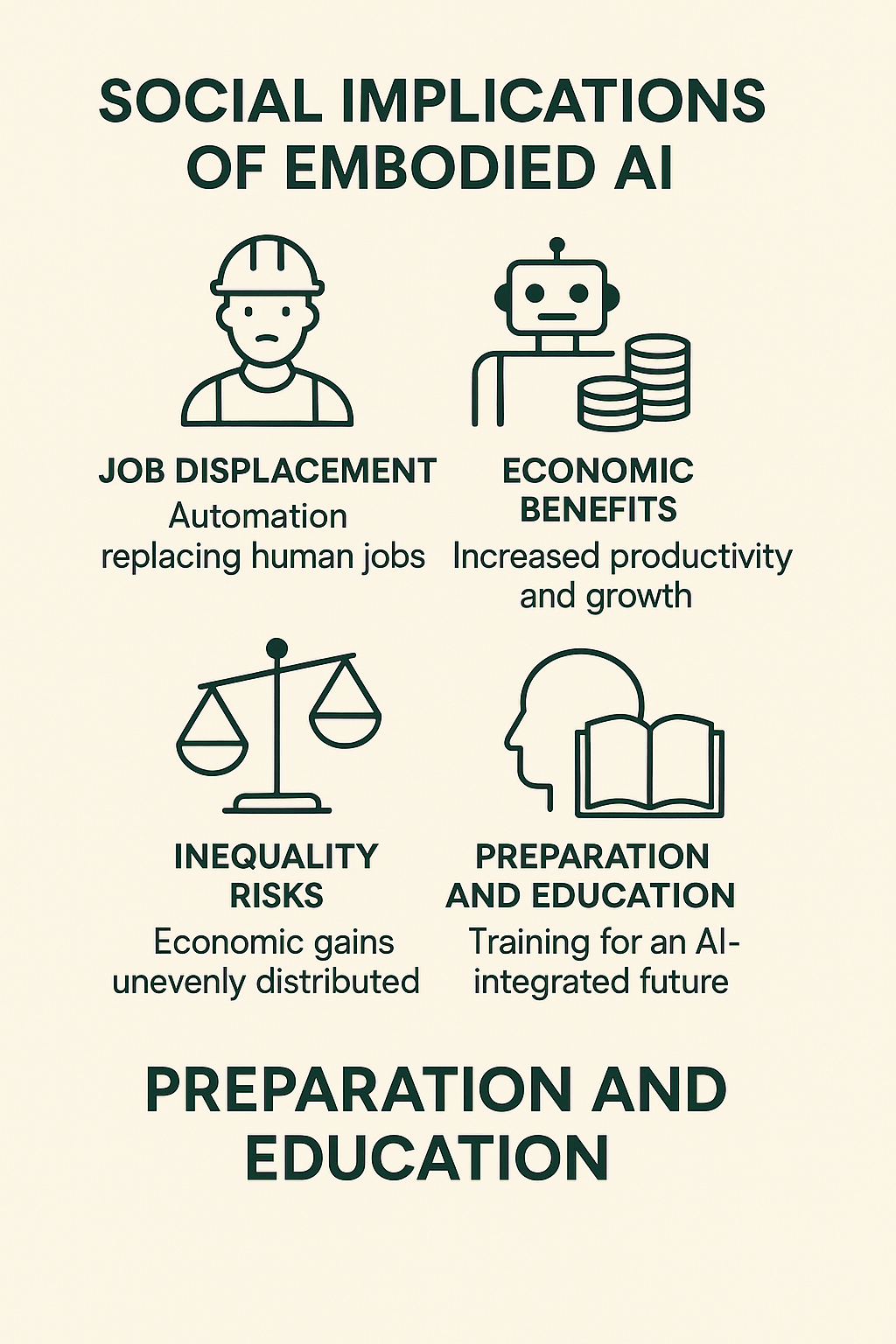
Current Job Displacement
The impact of embodied AI on employment is already visible in several sectors. According to McKinsey, by 2030, approximately 30% of current U.S. employment could be automated, with 60% significantly modified through AI interventions.
- Administrative roles: 60% of administrative tasks are currently subject to automation.
- Warehouse operations: Companies are utilizing AI to enhance back-office operations, resulting in cost reductions.
- Manufacturing: Research indicates AI might replace as many as two million manufacturing workers by 2025.
- Retail: 65% of retail jobs could be automated by 2025.
Economic Benefits and Concerns
- Cost Reduction: Autonomous inventory management systems can scan thousands of pallets per hour with high accuracy, dramatically reducing operational costs.
- Productivity Gains: By 2030, AI could potentially increase the total annual value of goods and services produced globally by 7%.
- Job Creation: While eliminating some roles, AI is expected to create new positions. The World Economic Forum concluded that 85 million jobs might be displaced, while 97 million might be created by 2025.
Preparing for an Embodied AI Economy
- For Workers: Focus on capabilities that complement rather than compete with AI, adopt continuous learning mindsets, and monitor automation trends in your sector.
- For Communities: Reform education systems, develop comprehensive policy frameworks, and ensure broad participation in shaping AI technology deployment.
- For Society: Implement education and retraining programs, ensure inclusive development, provide regulatory oversight, and maintain social safety nets during transitional periods.
Conclusion
Embodied AI represents a fundamental shift from digital-only AI systems to machines that interact with and learn from the physical world. From warehouse automation to disaster response, these systems are already transforming industries and might continue to reshape how we work, live, and interact with technology.
The development of embodied AI involves complex interactions between hardware, software, manufacturing, and social systems. Success in this field requires understanding not just the technical components but also the economic, social, and policy implications of deploying intelligent machines in our physical environments.
As we move forward, the challenge isn’t just building capable embodied AI systems but ensuring they’re developed and deployed in ways that benefit society broadly. This requires ongoing collaboration between technologists, policymakers, and communities to shape a future where embodied AI enhances human capabilities while addressing the real challenges of economic disruption and social change.
The next decade might be crucial in determining how embodied AI develops and integrates into our daily lives. By staying informed about these developments and participating in discussions about their implications, we can help ensure that this technology serves human needs and values as it continues to evolve.


